There’s a Super Bowl every day on social media. Not everyone’s got the memo.
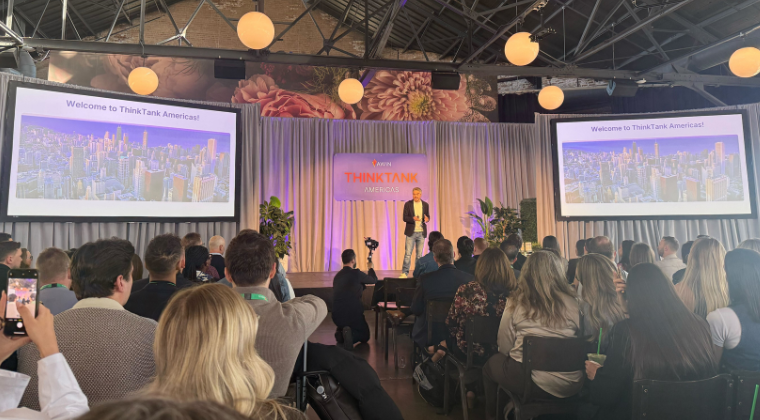
I was sat at Awin Global’s ThinkTank Americas last week in Chicago, listening to a keynote from Mike Cessario, founder of canned flavoured water brand Liquid Death that didn’t feel like a prediction of the future, but more like a very direct observation of what’s already happening right in front of us.
At one point, Mike made a comment that neatly reframed the entire marketing landscape in a single line.
“There’s a Super Bowl every day on Social Media.”
Same scale of audience, same potential reach, but with one fairly brutal difference, which is that nobody is forced to watch your ad, nobody is sitting patiently through your message, and nobody really cares unless you give them a reason to.
That one shift alone explains why so much of what we’ve all been doing over the last decade suddenly feels a bit ineffective.
The “Beige Decade” meets the scroll
For a long time, we’ve operated in what I’ve called the beige decade, where the goal was to create marketing that performed reliably, looked polished, and didn’t really offend anyone in the process.
It made sense in a world where distribution could be bought and attention was, to some extent, guaranteed, because if people were going to see your message anyway, you could focus on refining it, optimising it, and making it incrementally better over time.
But what that keynote made very clear is that we are no longer in that world, because the scroll has fundamentally changed the rules.
You are not competing with your category anymore, you are competing with everything that exists in someone’s feed, and in that environment, safe, well-crafted, perfectly balanced marketing stands much less of a chance.
Not because it’s bad, but because it’s ignorable.
If it looks like an ad, it’s already lost
One of the more uncomfortable truths Mike touched on is how quickly people disengage the moment something feels like marketing, because the second that “this is an ad” trigger goes off in someone’s brain, their attention is gone and they’re already halfway down the next piece of content.
That makes the first few seconds of anything you produce disproportionately important, not in a theoretical sense, but in a very literal one, because if you don’t earn attention immediately, you don’t get a second chance.
Which is why the traditional model of carefully crafting a message and pushing it out with media spend is starting to break down, because the assumption that people will sit through it simply doesn’t hold anymore.
The brands winning are creating things people would watch anyway
The most interesting part of the session wasn’t just the diagnosis, it was the operating model behind how they’ve responded to it.
Instead of thinking about marketing as something that supports the product, the approach is to treat it as something people would choose to engage with in its own right, which is a subtle but important shift in mindset.
That’s where a lot of the more unconventional examples come in, whether it’s taking negative internet comments and turning them into content, or creating ideas that feel more like entertainment than advertising.
Not because it’s clever for the sake of it, but because in a scroll-based environment, entertainment is the only reliable way to hold attention long enough for anything else to land.
Small bets, fast output, big outcomes
Another thread running through the keynote was the idea that nobody really knows what’s going to work, which sounds obvious but is often ignored in how marketing is actually structured.
The response to that uncertainty wasn’t to spend more time planning or refining, but to build a model that allows for more output, more experimentation, and more opportunities for something to break through.
That means producing content more quickly, more cheaply, and with less attachment to any single idea, because the goal isn’t to get everything right first time, it’s to create enough chances for something to resonate.
It’s a model that looks far closer to how creators operate than how traditional campaigns are built, which is probably not a coincidence.
As Rory Sutherland puts it, “not everything that makes sense works, and not everything that works makes sense,” which is exactly why the only rational response is to create more opportunities for those slightly illogical, unexpected ideas to actually see the light of day.
Why creativity is quietly winning again
When you step back from it, what that keynote really highlighted is not a new trend, but a correction that’s been building for a while.
The beige decade was built on control, predictability, and optimisation, all of which made sense when attention could be managed and distribution could be controlled.
Now that attention is fragmented and optional, those same strengths have become limitations, because they naturally lead to work that is safe, refined, and very easy to ignore.
At the same time, a smaller group of brands have leaned in the opposite direction, creating things that are more distinctive, more entertaining, and occasionally a bit uncomfortable, which in this environment tends to be exactly what is required to cut through.
The reawakening era is already underway
We’re not moving towards a creative resurgence, we’re already in the early stages of it – it’s just not evenly distributed yet.
Some brands are still operating as if attention can be assumed, continuing to optimise within familiar frameworks, while others have fully accepted that attention has to be earned every single time.
Those that have made that shift are starting to separate themselves, not because they have better tools or better data, but because they are approaching the problem differently.
They are not asking how to improve what they were already doing, they are asking how to create something people would actually choose to watch.
It also reflects a broader shift that System1 have been talking about for years, where the industry has leaned too heavily into salesmanship, focused on persuasion, messaging and rational proof points, when in reality the work that drives growth tends to be far closer to showmanship, built on emotion, entertainment and memorability.
As Orlando Wood put it when keynoting our intent.ly Live! event last year – “if you want to grow, you have to put on a show.”
So, WTF am I trying to say here!?
If the Super Bowl is happening every day, then it’s becoming increasingly clear that many brands are still operating with a model built for a time when attention was more predictable and far easier to secure.
That’s not a failure of creativity, but a reflection of how it was deprioritised during a period where efficiency and optimisation delivered consistent returns.
The environment has shifted, and with it the requirements for standing out. Creativity is no longer optional, it is the mechanism through which attention is earned.
And for ‘entertainment-first’ brands such as Liquid Death, those who have already adapted to that reality are not just outperforming, they are separating from the rest of the market in ways that will only become more pronounced over time.

Chris ‘Ceej’ Johnson is CMO at intent.ly. With over 15 years’ experience in digital, affiliate and performance marketing, he has a passion for all things consumer behaviour and innovative advertising.