The power of onsite segmentation
Segmentation has become a fundamental part of modern digital marketing. Brands invest in understanding their audiences and dividing them into meaningful groups through CRM data, lifecycle marketing, and paid media targeting.
Users are routinely segmented according to factors such as demographics, purchase history, engagement levels, product interests and lifecycle stage. These insights allow marketers to deliver personalised messaging across channels.
Yet there is one critical place where this segmentation frequently disappears: the website itself.
Despite sophisticated off-site targeting, many brands still deliver a largely generic on-site experience where every visitor sees the same messaging regardless of how they arrived or the behaviour they display. This disconnect represents one of the most significant missed opportunities in conversion optimisation.
Why Segmentation Matters Even More On-Site
The opportunity lies in extending segmentation into the on-site journey, where purchase decisions actually take place.
By the time a shopper reaches your website, they are already demonstrating a higher level of intent than earlier in the funnel, having already clicked an ad, opened an email, or searched for a product.
At this stage, the signals available to marketers become even more powerful. Behavioural indicators such as time spent on page, product views, basket activity and exit intent help to build a clearer picture of where the user sits in their individual purchase journey.
Moving Beyond Static Segments
Most marketing teams already operate detailed segmentation frameworks across their wider marketing stack. For example, users might be categorised as:
- New vs returning customers
- High-value vs low-value customers
- Category-specific audiences
- Abandoned basket users
- Lapsed customers
These segments typically shape how users are targeted through CRM campaigns and paid media with personalised messaging, long before they reach the website. However, once that user finally lands on- site, the experience often becomes generic.
This is where on-site behavioural targeting becomes powerful. By activating prompts, overlays or personalised messaging based on real-time behaviour, segmentation can continue throughout the browsing experience. The website becomes a continuation of the shopper journey, rather than a total reset.
While traditional segmentation focuses on who a user is, behavioural segmentation focuses on what they are doing in real time. These signals allow brands to move beyond static audience segments and respond to intent.
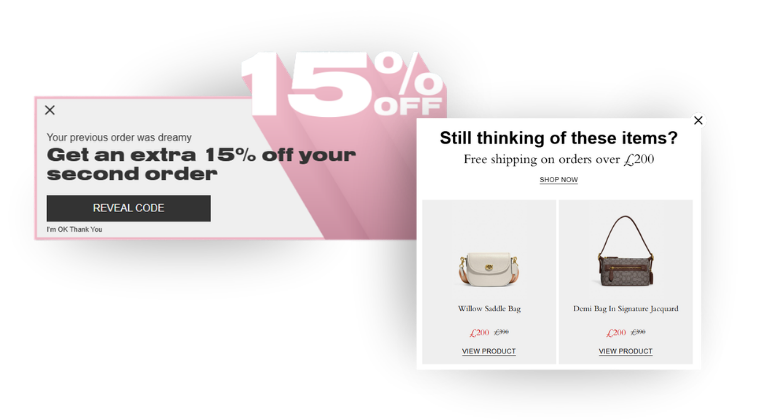
For example, someone who previously clicked a category promotion in a paid ad should see that promotion reinforced on-site. A returning user who abandoned their basket could be reminded of the items they were considering, or someone browsing multiple similar products might need recommendations or social proof to convert.
When messaging aligns with a visitor’s past interactions and their real-time behaviour, the journey feels more natural and intuitive.
Identifying High Intent Behavioural Signals
In practice, the segments that deliver the strongest impact on conversion are rarely broad demographic groups, but high-intent behavioural segments. For example:
- Returning visitors who previously abandoned a purchase
- Users who have added items to their basket but not checked out
- Users comparing multiple products
- Users revisiting specific categories
These audiences are already engaged and close to converting. In many cases they simply require a small prompt, reassurance or reminder to complete their purchase. These small behavioural interventions at the critical moment can significantly improve performance.
Targeting Key Moments to Reduce Friction
Segmentation becomes even more effective when it focuses on moments of friction within the customer journey. Different stages naturally require different messaging.
Someone at the early research stage may benefit from guidance towards relevant categories or product discovery support. Visitors comparing products might respond better to messaging that highlights product reviews, key differentiators or recommendations. At the basket stage, reinforcing value through delivery information, guarantees or urgency can help maintain momentum. During checkout, reassurance messaging can address hesitation and reduce abandonment.
Recognising these different stages allows marketers to intervene at the exact moment where hesitation occurs, rather than delivering the same message to every visitor regardless of intent.
Testing and Optimising Segments
The most effective segmentation strategies are refined over time based on behaviour and campaign performance, and A/B testing plays a critical role.
Through experimentation, teams can validate which segments respond best to different messaging, determine whether interventions drive genuine incremental conversions, and refine the creative used to engage different audiences.
Over time this testing process helps identify the segments most responsive to prompts, nudges or personalised messaging, allowing teams to scale what works and discard what doesn’t.
Segmentation at the Point of Conversion
Segmentation has long been recognised as a powerful marketing tactic, but brands often focus on the traffic acquisition stage. The next evolution is ensuring segmentation continues throughout the on-site experience.
When off-site targeting, CRM messaging and on-site behavioural triggers are aligned, the customer journey becomes significantly more cohesive. Visitors encounter messaging that reflects their previous interactions and their current behaviour, creating a smoother and more intuitive path to conversion.
For brands looking to maximise the value of their segmentation strategies, the opportunity is clear: extend segmentation to the point where purchase decisions are actually made.
–
Curious about implementing segmentation tactics? Contact our team to learn more.